Popular Posts

Monday, January 11, 2016

ELKHORN HOT SPRINGS AND HOME FRIES

I am sitting in my jammies under a giant 6 x 6 elk head in the darkened lobby of Elkhorn Hot Springs and Lodge in Polaris, Montana under the light of the only lamp that is on tonight. It is only 9:00 pm. A few moments ago, I walked over from the Hot Springs building after my soak for the night. The stars are very, very bright tonight; a faint smudge of the Milky Way streaks across the sky. It is so cold that on the short trek back my body, even heated up from the hot springs pool, began to chill as we walked the short distance from the pools to the lodge. But now I am warm, sitting in my little pool of light, thinking about how vastly different are the lives of people that intentionally shuck the business of business in the city to live more simply in remote villages like this.

Besides my son Daniel and me, there were a handful of lively young people playing beach ball in the smaller of the two outdoor pools of the Springs. I spoke to one young man who is living the life here in remote Montana, working three days a week at the very local ski resort, Maverick Mountain, trying to make enough with that and occasional other work in the Polaris Valley to live in a place that bleeds serenity. I have met people like this – people who work in Yellowstone or Glacier or other remote Western villages. You can often find them at the day’s end at places like this hot springs or at the local watering hole.

I don’t like to use the word ‘rustic’ to describe these remote mountain places. To say that Elkhorn Resort is rustic is so subjective. Some people would consider the hotels and homes in Vail, Colorado ‘rustic’ for example, but that kind of very planned and very perfect rusticism is a far cry from the eclectic themes of places like this. Elkhorn’s main decorations in the lodge are hunting trophy heads and Audubon-like drawings of trophy heads. The 6x6 elk and another enormous trophy head of a moose have the prime corner over the sofas. I am guessing that in its long history, this place has been a popular hunting lodge. I would say Elkhorn lies somewhere between shabby and chic without really being either one of them. Their website calls their décor “spartan” but it is also clean and warm and homey which suits me just fine.
 
I’m sure when they are very busy, the barman bustles at the old bar in the main gathering room of the lodge. But it is a Sunday night in the middle of January. Only two of us are staying in the main lodge tonight with another two staying in one of the rustic cabins on the property. The lodge has the feel of a big family house where you are a guest, expected to get your own water from the tap behind the bar and to feel free to top off your coffee in the morning. Where you are welcome to bring your late night snacks down to the tables set for tomorrow morning’s breakfast and to pull a brew out of the bar frig late at night as long as you leave a note to add it to your bill.

Getting to Elkhorn from Missoula means driving through yet another of Montana’s astonishing valleys, the Bitterroot. Small towns break up the unending range land, mountains paralleling on either side. On this trip, snow starts at the edge of the road and runs all the way in an unending blanket to the top of the mountains on both sides.

Long past Hamilton, the 4-land divided road becomes narrower and snow blew across road the closer we got to the valley called Big Hole. We had not had cell service for miles. The road stays mostly clear until we get past Big Hole, the locus of one of the biggest mistakes in the Indian Wars – a massacre that killed many innocent Nez Pierce women and children and nearly wiped out the troops that did the killing. The Big Hole valley is wide and luscious – certainly a valley worth fiercely defending as the Nez Pierce did.

Leaving the Big Hole, we drove through Wisdom and Jackson, small towns with a few ranches and several summer cabins punctuate the snowy landscape. It is good to be reminded that it is still possible to find small, local places like this one. We finally arrive at Polaris and then Elkhorn Hot Springs, our destination for the next few days. Where we find the locals outnumber visitors in January but treat them as old friends. 

No one locks their door here. We were not given a key for our room upstairs. “You don’t need one.” the guy taking the money for the rooms and handing out the towels at the hot springs pool says. Neighbors are neighbors here. Implicit is that you will be a good neighbor too.

Tomorrow Daniel and I are on the hunt for good cross-country skiing. We have been assured that we will find that abounds in the forest roads closed for the winter. Just strap on those skinny skis and go. Between the skiing, the stars, the hot springs and the well-prepared full egg and home fries breakfast we were presented as part of our 'package', I think we will leave Elkhorn feeing well cared for indeed.

Tuesday, January 5, 2016

DASHBOARD DINING AND BAJA BEACHBUMMING

I hadn’t been to Baja for a very long time. About 27 years actually. One would think in almost a quarter of a century things have changed – and they have somewhat. But the beaches and bays are still beautiful, you still have to have pesos (not credit cards) in a whole lot of the Baja and you MUST still carry toilet paper. Just in case you would like to wander on down to that glorious peninsula called Baja California, I thought I’d share with you some things I learned or remembered for traveling down there.

Guadelupe Hot Springs Rd


Dashboard dining – really this tip is about not thinking of the mileage in Baja like you would in the States – unless you live in some of the vast Southwest where the ‘roads’ are named something like “The Devil’s Road” (but that’s another story). PLAN on taking your time over the rough and sometimes downright primitive roads you will encounter regularly if you veer off one of the three main paved highways down the Baja. You might want to pack a lunch and eat on the way. You’ll be going slowly enough to eat your lunch and digest it too!


Stuck in the sand – Optimally, you will benefit from a 4WD but I drive a 10-year-old Tacoma 2WD Offroad and Yeehaw seems to take most of what the Baja offers just fine. Including the supremely rocky and rutted road up to Guadelupe Hot Springs which is not to be missed just because there are boulders you will need to squeeze by going up the mountain as well as fording a stream that you think is high enough to leave you with wet feet in your high clearance truck. Actually, these road hazards Yeehaw handles just fine but she HATES sand. Poor girl gets stuck if the sand is only surface stuff. Like on Gonzaga Bay at Punta Final where I drove off the firmer ‘road’ on to the sandy beach. Faster than you can say "UY!", Yeehaw’s wheels dug right down into the sand. I had purchased the Maxsa Sand Planks just in case and we had our first opportunity to use them to dig out one of the four vehicles we were traveling with. But I felt okay about that when we had to use them on two of the three 4WDs traveling with me. I’m telling you, the more you want to overland it, the more you ought to consider buying sand planks. There are several makes but after researching them I bought the Maxsa which is a middle-priced, bright orange plank that comes in pairs for about $150 dollars. This is a link to a little video of the first time we used them: Sand Trap

Money conversion – I swear if I had to do it again, I would download one of those conversion aps that DOES NOT REQUIRE WIFI to give you an answer. I just could not wrap my head around the fact that 1000 pesos is only like $55 bucks. So when you are at the Border, stop in at an exchange and get LOTS of pesos for food, grocery stores and even gas stations (more on that below). But never fear, fortunately cerveza is only 25 Pesos (about $1.50). Of course, it’s ‘all Bud Light’ you will be told if you are thinking you are going to find a Kiltlifter on tap. It’s not REALLY all Bud Light but it IS all Bud Light wannabes – Pacifico and Corona being the most common. Mexicans like their food spicy and fresh and their beer…..light.

Gas and Gas Stations – So most all of the gas stations on Baja will be Pemex, Mexico’s nationally-owned gas company. Generally, the gas didn’t seem as dear as I thought it would be. Higher than Arizona for sure and maybe even California although probably not as much nearer the Border. In the interior? You might want to research that before you travel on down the Baja. And be aware that the further south you get and away from Baja’s bigger cities (Border towns especially), even though most Pemex’s are supposed to have credit card machines, this won’t do you any good at all if the Pemex is in a town that has just lost its wifi to high winds off the Sea of Cortez or the technology of the village is just not up to the task. Make sure you have plenty of pesos for gas stations that are still on the cash only system – or might as well be.

Toilet at Dagget's Campgound
One more thing about gas stations – their toilets are generally slightly more reliable in terms of cleanliness than most other places at your option. Although the one Pemex in Gonzaga Bay didn’t have water so its toilets wouldn’t flush so it was really just a toilet in name only. You might come across one that has an attendant and you might want to pay the attendant for ‘cleaning’ up after you – and giving you a bit of toilet paper if you happened to not remember that most necessary travel item. Generally, count on having to supply your own toilet paper at all times. It’s just easier and more sanitary for everyone. And remember, if there is a large trash bin next to the toilet – that means the waste disposal system is a bit wonky so just toss your used TP in the bin – even if it offends you sensibilities. You are doing the next traveler desperate for a working toilet a favor.

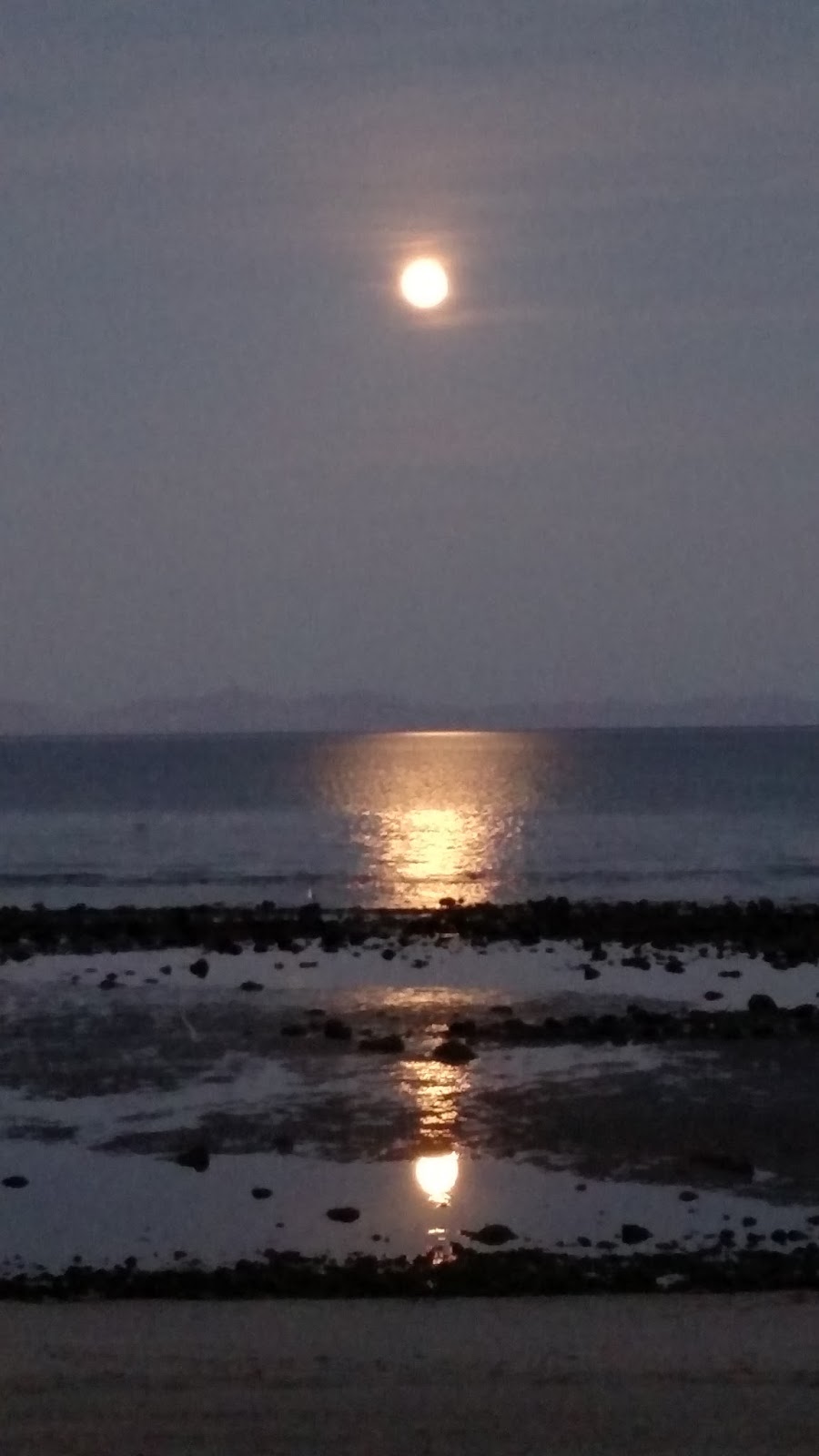
Moonrise over Punta Final
Sleeping on the beach – that’s what most of us come down to the Baja to do – or at least NEAR the beach. One thing I learned this trip – if you are going to sleep in a tent, make sure the tent is low-profile. I had along my Coleman 4-person which practically taco’d in the wind coming off the sea. A good choice would be one that was designed aerodynamically to resist the wind. Sand stakes or, as most of us had, sand bags are also very useful in stabilizing your tent. Most beaches will have ‘palapas’, small grass shacks which are perfect for extra wind and sand protection. Just pitch your tent and set up your kitchen in the palapa. Also, back to toilet habits, it is acceptable to pee on the beach as long as you walk all the way down to the tide line. If you pee anywhere else, it will begin to smell like the inside of a primitive state park latrine.


Have no fear – OK, things are different in the Baja. Restrooms are not up to our cleanliness standards; you can’t drink the water (seriously don’t); spending your pesos makes you feel really poor really fast until you remember the exchange rate. Sand gets in your crotch and your shoes. Obviously Mexico has not had the pleasure of having a Lady Bird Johnson clean up the sides of the highways (more prevalent closer to the urban areas) and the soda isn’t cold and the vendor’s shop has a whole bunch of knickers (everything from whitie-tighties to thongs) hanging from his ceiling (DO stop at Coco’s Corner on the way from Gonzaga Bay to Bahia de Los Angeles).

Coco's Corner on the 'road' from Gonzaga Bay to Bahia de Los Angeles
BUT you can find a mechanic in a small village by just continuing to ask around until you are given directions on how to get to his house where your host is certain you will find help for your ailing truck. You can find Aqua Purificata vendors for purified water and the much needed ice for your coolers in all but the smallest villages. The proprietors of the restaurants serve you delicious, fresh food and make sure you know they are glad you are there. The gas station attendants are courteous and don’t laugh at your horrible Spanish. Sometimes you can get away with breaking a traffic law you didn’t even know you broke by being polite and nodding to the nice policeman a lot (yeah, that happened to me).


Remember, too, that Mexico is a developing country, our neighbor to the south – light years further along in their development of a strong middle class than even ten years ago. These are the people that are going to continue to come across our southern borders to buy our manufactured goods, assuming that our expectations of perfection means their purchases will last longer, look better and work more efficiently than ones made in Mexico. Step out of your fear zone and you will find warm and hard-working people happy to see you, happy that you have chosen their country, their Baja, their village to visit. And you will be happy that you have.

Sunrise at any beach on the east coast of the Baja

Sunday, December 6, 2015

THANKSGIVING AND GIVING THANKS

It is gently snowing outside. The air is crisp and very cold – it must be around the low 20s. It is growing dark; the moon is not up yet. I know it will be beautiful when I take my last trek to the communal toilets. I am reluctant to leave my tent. The quiet huffing of my Buddy heater gives me at least an illusion that it is somewhat warmer here inside the tent than out but in all honesty, my frozen fingers keep hitting the wrong keys. I haven’t slept outside in a tent in this kind of cold for years.

And this night I would rather be here on the South Rim of the Grand Canyon than anywhere else in the world -  except perhaps down at the bottom with my adventurous friends at Bright Angel Campground near Phantom Ranch. I should be there, too; that was the plan. But life often provides one doors for one to decide to step through or to resist opening, all the while lamenting that the door is too heavy or sticky or whatever to move forward.

I’ve had to step through a lot of doors in my adventurous life. I’ve been laid up with a case of cellulitis from a kayaking injury off the Channel Islands, fractured my shoulder, sprained my ankle yet another time, torn yet another ligament. If you live adventurously, injury is part of the package no matter how careful you might be. Fortunately, while all of these may have left small tokens for me to remember them, I have always recovered – quickly. In each case, the doctors admonished me to be still, give up my activity for a few months, give my body time to recover. Honestly, giving up activity even for a 62-year-old person who has been hyperactive all her life is almost impossible.

This morning I was supposed to awaken in the relative warmth of my down sleeping bag at the bottom of the Grand Canyon. The Grand Canyon is very familiar to me; I have been down into its inner canyons many times. I raised my son backpacking there. This trip was my way of going ‘home’ for the Thanksgiving Holiday.

But then again, there’s Life erecting one of those doors. A door that prompted decisions. Late this July, not feeling well, I visited my doctor. From my doctor’s office, I was taken in an ambulance to the emergency room at which I was declared as actively having a heart attack. From there I was whisked up to intensive cardiac care to await an emergency surgery. As I was wheeled through the door, my adventure buddy and cardiac case manager Alice leaned over my gurney and asked me “I was wondering if the Beth Haas on my chart was you. What are you doing here?”

Darn good question. No heart disease in the family that wasn’t brought on by old age. No diabetes. A long, long active life. Honestly, it seemed at the time that this was happening to someone else - not me, not the 15-year-old who was still climbing trees. Not the 30-year-old that hiked across the Grand Canyon for the first time. Not the 40-year-old who backpacked her 5-year-old across that same Canyon for the first time. Not that 50-year-old who danced under the Eiffel Tower at midnight on her birthday. Not that 60-year-old who snowshoed around by herself in a beautiful quiet snowy forest for several hours with only the breadcrumbs of her snowshoe imprints to lead her back to safety. Not the 62-year-old who had planned and already obtained the coveted permits for a Thanksgiving trip down into the bottom of the Grand Canyon, taking 5 of her adventure buddies with her. Not me. Not that active woman.

But there I was. As I was wheeled in to my room, the door to the cardiac unit started swinging shut behind us. That door. That extremely inconveniently timed door. Eventually, my doctors and I finally figured out that my heart does not respond to activity in the way everyone else’s does. And THAT is a condition with which I am stuck. That door. That most inconvenient, life-altering door. And every day I am reminded as I start to ride my bike or even step on a treadmill that my physical heart is just not into it without chemical help. Really. My choices for the future will be dictated by this heart that generously let me do all kinds of things for years without letting me know that part of it was wearing out.

I can think of the heart attack as the end of something that feels so intrinsically ME that I stop in my despair and decide to no longer go on my adventures. Be safe. Live a long life. OR I can decide to test out the limits of my condition and keep on adventuring within new limits. Perhaps testing my limits may mean a shorter life as I place my dicky heart under more strain than I ‘need’ to. Same door but the outcome will be very different depending upon my response. And I have made my choice to live – truly live.

So here I am at the freezing South Rim while my buddies are down in the Canyon, eating dinner at the Phantom Ranch Cantina. It’s so cold here that I am not even TRYING to cook anything. My fingers are too cold to turn the gas valve on my Jet Boil. And I am completely at home. I know my down sleeping bag will keep me warm. I trust that my friend Max’s deluxe tent is sound and safe if the winds pick up. I am grateful that he left me a super-sized, super-warm sleeping bag in which to burrow into with my own down bag. 

And I have decided in just the last few days that the day after tomorrow I will join them at Indian Gardens, half-way down the canyon. Testing my limits. Asking my heart to give me at least one more backpack. More if I stick to my bargain with my dicky heart and take it easy on the 4.5-mile trek back up to the South Rim with 30 pounds on my back.

I can hear the whoosh of the ravens as they check my campsite for orts of anything interesting. Haha ravens – I am a clean camper and I win this game.  I hear the yips and howls of the coyotes hunting in the night reminding me that I am not the only one in this nearly deserted campground. I hear small clumps of snow gain enough weight to lose their purchase on the slanted top of the tent and fall quietly to the ground.

And I am so very grateful that I am here at all. That door, that very inconvenient door, may lead me to wondrous things that I might never have thought of before its opening. That door. That beautiful door of uncertainty and promise.

Sunday, November 1, 2015

THE ALOHA MIND

Having only visited Maui and Kaua’i, I cannot speak for the entire Hawaiian archipelago but on those two islands, and particularly Kaua’i, the warmth and generosity of the Hawaiian culture is literally palpable. Upon arrival, you are immediately greeted with that all-encompassing and beautiful word – Aloha. Your first Aloha on Hawaii is delivered with genuine smiles, warmth and most importantly welcome.

Aloha means significantly more than ‘hello’. Curby Hoikeamaka-Rule, a Hawaiian dedicated to furthering the understanding of Aloha Spirit, recounts one of the ‘old teachings’ of early Hawaiians:
Aloha is being a part of all, and all being a part of me. When there is pain - it is my pain. When there is joy - it is also mine. I respect all that is as part of the Creator and part of me. I will not willfully harm anyone or anything. When food is needed I will take only my need and explain why it is being taken. The earth, the sky, the sea are mine to care for, to cherish and to protect. This is Hawaiian - this is Aloha!
Embedded in Aloha is commitment to balance – a system that is sometimes also used to describe Huna, an ancient way of thinking about the earth and its beings. For Hawaiians, living on a remote archipelago of relatively small islands, this meant devising complex resource management systems for living off the land and the sea, taking only what was needed with an eye to the needs of future generations and working in tribal groups to provide food and shelter for all who would help. Young Hawaiians grew up being told “if you help, you eat”. 

As island life encouraged and was dependent on a cooperative culture for food and safety, sharing became a very important part of the culture. These intrinsic cultural values of environmental stewardship and cooperation were passed down through oral traditions that included songs, storytelling and dance. These values and ways of existing varied little among the various islands of the archipelago even though each island had its own unique governmental systems.

At the time Captain Cook arrived on the Islands, the archipelago was divided into monarchies which had been consolidated into island groups. These kingdoms were briskly trading with each other and even other Pacific Polynesians. By 1795 King Kamehameha's monarchy consisted of all islands but Kauai and the King had banished the old Kapu system of behavior which particularly discriminated against women. 

With this abandonment, Hawaiians largely gave up their belief in their ancient polytheistic gods and Missionaries brought Western culture and Christianity to the Islands in 1820, the Christian god, with his rules and Commandments, quickly filled the void. To this day, Hawaiians are very religious and a tour guide may start his or her visitors’ tours with syncretic prayer that blends the ancient beliefs with the Missionaries Christian God, praising and thank God for the gift of the Islands and asking safety for the guests on the tour (as did our tour guide in Maui on the Road to Hana).

The missionaries also brought something else to the monarchies - written language. By then the monarchies were already enthusiastically engaged in trade with western countries and readily assisted the missionaries in building schools so their subjects could learn to read and speak English. The missionaries also developed an alphabet to capture the previously oral Hawaiian language. In 1896, the Hawaiian population was one of the most literate in the world.

Eventually, even with the development of the Hawaiian alphabet, the Hawaiian language was abandoned as English became the legal language of public education in Hawaii. Dancing the hula, which had been forbidden by the very conservative missionaries who had introduced Christianity to the Hawaiians, along with much of the accompanying traditional chants and instruments became a lost art. Western cultural values began to overcome the Aloha mind.

By then, Western entrepreneurs had begun to turn their attention to the verdant valleys of the volcanic archipelago and much of the cooperative subsistence cultures on the islands were lost to large corporate plantations of sugar and pineapple. Native rights to tribal lands were severely limited and Hawaiians started working for pay in the sugar, pineapple and taro farms, losing their intimate connection to the land, a historical connection that informed their very cultures and ways of belonging and behaving in groups.

The Aloha Mind, however, though submerged by Western culture, was never entirely lost. After Hawaii became the 50th State in March 1959, Hawaiian culture began a slow reemergence. Hawaiians began to reclaim their culture, and interest in ancient indigenous arts and skills was rekindled. In the early 70s, an Oahu based artist named Herb Kane, deeply interested in ancient Polynesian sailing, began a giant country-wide effort to revive the lost ancient skills of building sea-worthy outriggers as well as navigating, route-finding and wayfaring. 

These ancient skills had been completely lost to Hawaii but with the help of native Micronesian Mau Pialiug, Kane and other sailing enthusiasts were able to launch the Hokule’a, a double-hulled outrigger built in the traditional way, on March 8, 1975 for its first visit to the other islands of Hawaii. At its first port, Honolua Bay on Maui, it was met with enormous enthusiasm by the public. Kane’s efforts to revive Polynesian voyaging were credited with lighting the fire under what was to become known as the Hawaiian Cultural RenaissanceIn 1978, just a few years after the launching of the Hokule’a and over 80 years since English was given legislative status as the ‘official’ language of Hawaii, the state’s constitution was amended and the study of ‘Hawaiiana’ was accorded special promotion by the state (timeline provided by http://www.summ.org/tj/hi-report/timeline.htm). 

The Hawaiian Cultural Renaissance would continue into the 80s with the first ‘immersion school’ opening on Kauai to encourage knowledge of the culture and language of Hawaii. Soon others were to follow on the other islands. Old ones still adept at making ropes and leis began teaching a new generation of craftsmen and women. And classes in hula, the quintessential Hawaiian dance and story-telling, once again were offered in cultural centers.

Natives are once again proud of their heritage and eager to share it. Most visitors to the Islands will attend at least one ‘luau’, a traditional dinner and celebration of dance and culture. We did. What we witnessed and experienced in Old Lahaina Luau felt much more than just theater and entertainment to the dedicated and talented dancers and musicians at the luau. It was evident in their descriptions and their movements that these ancient arts are ways they demonstrate their pride in their heritage.

As a visitor to the Islands, it is hard not to be caught up in the Aloha Mind. It is much easier, even briefly, to let the island pace and courtesies flow into your own experience of Hawaii and then to want to carry that mindset back to the mainland. And when you get back, you might even wish for opportunities to share the Aloha Mind, with its beautiful ‘aloha’ and ‘mahalo’ with your friends and family back on the mainland, remembering and teaching others that "The earth, the sky, the sea are mine to care for, to cherish and to protect." 

Sunday, October 25, 2015

SWIMMING WITH SEA TURTLES


The first time I ever saw the beautiful set of Elvis Presley’s 1964 Blue Hawaii I was only 10 and had no idea the movie was filmed on Kauai. My Mom, an avid Elvis Presley fan, took my sister Jenny and me to every Presley movie that was shown at a local drive-in movie theater called the 40-Hi Drive-in.  I watched Elvis swivel his hips to vaguely Hawaiian rhythms (and probably swiveled my tiny hips along with Elvis) but had no cultural context in which to appreciate the amazing beauty of the scenery and the remarkable abilities of the surfers and hula dancers filling in the ‘local color’ for the movie.

I finally got to visit beautiful Kauai in person last week. Little did I know that by the end of my visit not only would I have waxed nostalgic over those late-night Elvis movies with my Mom and sister Jenny but I would have shared a swim with ‘Honu’ (Hawaiian Sea Turtles).

Kauai is called The Garden Island for good reason. Kauai’s beautiful beaches and stunningly green craggy mountains have attracted many famous movies since White Heat in 1934. But as beautiful as movie-set Kauai is, it has a very residential, almost rural, feel with lovely resorts, like The Point at Po’ipu and the Grand Hyatt next door, interspersed among residential neighborhoods of all types. To get to the resorts, most of which are on or near a beach, it is not uncommon to drive past pastures and orchards, horses and cows. You wind up at your resort destination already prepared to relax and enjoy the slower pace of this lovely island.

Po’ipu, where we stayed, is an area with several beaches, including Shipwreck (just to the east of Point and right behind the Grand Hyatt) which is aptly named for its big waves and rocky reefs. Po’ipu Beach, just 5 minutes away, is a neighborhood beach where high school surfers practice on the bigger waves at the west end of the beach while paddle boarders, well beyond the breaks, make it seem really easy to stand on a board just a little bit bigger than a surfboard, paddling through the genesis of waves that send small children tumbling to the shore. In the safe waters protected by the outer reef, families play while snorkelers like my sister Becky and I enjoy the many species of tropical fish that inhabit the area (see my blog post The Chubs in Paradise). Po’ipu is also a favorite beach for the endangered monk seal which shares the warm white sands with the families, surfers and snorkelers.


Po’ipu has the equivalent of a neighborhood bar with the  bartenders at Brennecke’s Beach Front Restaurant pulling a regular’s drink choice before the person has pulled up a bar stool, as locals converse about how improved some of the high school surfers have become and how long the migrating monk seals napped on the beach. Brennecke’s, on the second floor across from the beach’s lifeguard station and restrooms, is the kind of place locals rub elbows with the guests, dispensing advice on everything from where to sun, snorkel and surf to which local beer is the best.

I admit, places like Brennecke’s can be found all over the island; Brennecke’s was just the fun, welcoming bar in OUR neighborhood. Driving up the east coast to the end of Highway 50 to the trailhead of Kauai’s famous Na’Pali Trail, we stopped at the popular and crowded Kalypso’s for a delayed breakfast. Here, too, the locals, an interesting mix of flaxen-haired surfers, families, grizzled islanders and businessmen and women stopping by for breakfast, were friendly and generous with their advice.

The little village of Hanalei is the last one along Highway 50 as it rather abruptly ends a few miles later at Haena State Park. There, Becky and I toured the ‘wet and dry caves’ and I had a chance to talk to one scruffy local who has walked the 22-mile round trip Napali Coast Kalalua Trail - twice. He confirmed the beauty and the treachery of the trail which follows is a thin shelf cut above the beautiful but dangerous rocks and cliffs of Kauai’s Napali Coast. I had seen a couple (well really kind of a bunch for one trail) of warning signs at the beginning of the trail, vowing if I could, I would be bringing my fellow adventurers here in the next year or so to experience this once in a lifetime trail. 

Backpacker Magazine ranks the Kalalau Trail as one of the ‘world’s most paradisical (sic) beaches’, despite it also being ranked one of America’s 10 most treacherous. The trail ends in the gorgeous Kalalau Valley and Beach which can only be visited by boat or on foot along this particular trail. Beautiful, remote and treacherous – sounds like it might be a place that offers astounding beauty and solitude. Just my kind of trail.

The next day we first toured and snorkeled the Napali Coastline from water on one of Captain Andy’s beautiful catamaran sail boats. Captain Rick was full of information about the early settlers (Hawaiian) to the Napali Coast valleys and pulled the catamaran close to the cliff walls so we could enjoy the many waterfalls falling from the cliffs. The winds were too tricky that day to sail but our boat’s engines carried us up to the last waterfall on the west side of the island well past Kalalau Valley carved out by rain drainage of millennia. As the boat moved north from Kalalau Valley, I could track the thin horizontal line of the Napali Coast Kalalua Trail above.

On our way back, although Captain Rick noted that the ‘little swim’ we would be offered would be in waters too murky for really good snorkeling, we were encouraged to gear up and enjoy what we could. My sister Becky was one of the first to notice a sea turtle which kept dipping down to hide in the coral below us. A small group of us, further away from the boat and closer to the ever-present danger of the reefs nearer the cliffs, tracked that turtle and a larger one until one of the Captain’s sailors paddled his surfboard over to tell us we were too close to the reef for safety. Exhilarating.

After the snorkel, the catamaran flew swiftly back the direction of Port Allen. As we rounded the southwest corner of the coast we encountered a headwind and ‘reverse waves’ which have the effect of slamming the waves together so quickly that the front of the boat is just recovering from one wave before it gets hit with the next. This can have the effect of causing serious seasickness but if you have the courage to sit on the front of the boat, hanging tightly to whatever chrome safety bar is available or lie on the ‘trampolines’ which cover the area between the hulls and the main platform of the boat, you will escape sea sickness AND have the ride of your life.

Anyone lying prone on the ‘tramps’, holding tightly to the ropes holding the tramps up, WILL get wet. A group of giggly little girls, having commandeered one tramp, screamed with scary pleasure each time the wave came up from underneath and through the tramp, lifting their small bodies, still prone, up and off the tramp. Their infectious fun spread like a virus to us adults. I swear it was better than DisneyWorld’s Splash Mountain. Oh the other hand, the less adventurous on the boat gathered in a miserable seasick clump in the most stable part of the cabin, wishing the ride was over.

Safely back ashore, Becky and I headed to the end of the paved road on the west side of the island, past the very beautiful red rock and greenery of Waimea Canyon, called the ‘Grand Canyon’ of Kauai.  We stopped in verdant and tidy Koke’e State Park to find out about cabin rentals and trail descriptions in its tiny museum and visitor center. Now pay attention to this. The paved road ends beyond Koke’e above Kalalau Valley (remember the trail?) but by the time we got there we were literally in cloud. Had we been able to see the valley, we would have been looking down one of the same valleys we had seen from the boat.

After almost every trip I wind up asking myself ‘Would I go again?’ Most of the time, I admit that if I have a choice of somewhere I’ve never been before rather than a place I’ve already been, I opt for the potential of the unknown. But Kauai is justifiably proud of its beautiful interior and coastline. And although Kauai is one of the smaller islands of the Hawaiian archipelago, only 33 miles across, I feel like I have barely experienced the beautiful genuinely sweet island of Kauai. I am already planning my next trip.

Friday, October 16, 2015

CHUBS IN PARADISE

I made my acquaintance with a most unusually colored fish today. It looked like a cartoon fish colored by a kindergartner with a box of 500 crayon colors. The fish is as brightly adorned as one of those jungle parrots which is probably why it’s called a parrotfish – but since it’s a Hawaiian parrotfish its way more complicated but colorful name is Uhu Bullethead Parrotfish.

The parrotfish, which I named Matey, was one of many circling my sister and me as we snorkeled off Poi’pu Beach in Kaua’i. We were cheating just a bit. The young Hawaiian cashier sold us a tube of fish food (the tube itself biodegradable and edible for the fish) to dribble out around us to attract the colorful reef fish as we snorkeled. Good idea, right?

Yeah. Matey and his buddies were hard to woo any closer than the near ocean floor while a group of more burly fish, called Enenue Lowfin Chub, muscled right up to the bag to nibble on either it or our fingers depending on which was easiest. The chubs circled us like hungry sharks, almost touching our bodies with their lightly striped yellow and gray bodies. Nudging us, pushing us. Kind of disconcerting. You’d think since they didn’t mind pushing us around a bit, they wouldn’t mind if I reached out to touch them. But no, I’m pretty sure they do not grasp the idea of reciprocity.

All this togetherness was going on at the same time the swell was pushing us back and forth in the water. I don’t snorkel that often and it always takes me a bit of time to relax and trust my diving mask and snorkel. Living with asthma adds a layer of discomfort at the idea of breathing through a skinny tube that could be swamped by salt water while swimming above an ocean floor which is too deep for me to stand to recover myself.

However, when one is in Kaua’i, trust me, you really should snorkel off one of the beaches. Renting a snorkeling package means you get the mask, the snorkel and the fins (if you want them the fins really help when you are swimming against the wave action). Surf and snorkel shops are ubiquitous; every beach will have one or more nearby.

The fish food is optional – you might see lots of brightly colored fish anyway but the fish food is like crack to the reef fish. In just seconds you can be surrounded by a crowd of brightly colored reef creatures that include Matey and Chubby’s chums as well as Manini Convict Tangs wearing their black prison stripes over their yellow bodies, the Nunu Pekes (Coronetfish) looking as anorexic as haute couture models, the tiny Pennant Butterflyfish with its long spikey dorsal fin emerging from its back. These colorful creatures are just the showiest of the native species. Many other perhaps less colorful but no less interesting fish also circle with their show-off buddies.

Once we were tired of defending our honor among the gluttonous chub, we swam back toward the beach over the submerged rock to find not one but two endangered Hawaiian monk seals taking a break on Poi’pu Beach. Monk seals are treasured in the Islands and lifeguards are equipped with yellow caution tape to encourage us humans to leave them alone while they nap right next to sun-screened sunbathers before returning to the water.


All in all, quite an adventurous two hours on a Hawaiian beach. I’m glad we had a chance to practice snorkeling; we are headed for the world-famous Na Pali Coast on Sunday. Here we will snorkel over living coral reefs from a comfortable catamaran.  Kaua’I is called Hawaii’s Garden Island which is obvious even before your airplane touches down at Kauai’s Lihue airport. Between the colorful fish and the tunnel of trees we drove through to get to our resort, we truly feel like we are in a Garden as beautiful as Eden. And the most snake-like thing we’ve seen so far are tiny spiney lizards doing pushups on the sidwalks before disappearing into the bushes at our resort.

ALOHA!

Thursday, September 24, 2015

AFFAIRS OF THE HEART

I haven't blogged for awhile. I had a reason. It's not that I haven't had adventures to write about. Matter of fact, I've recently been on one of the biggest, scariest adventures of my life.


Eight weeks ago, I suffered a heart attack. Believe me, when I called my ‘medical power of attorney’ and told her she might be needed we were both REALLY surprised. I’m only 62. I consider myself an ‘active’ senior. I hike regularly, backpack when I can, have been practicing yoga for years, and cycle in the annual El Tour de Tucson road race. I rarely eat packaged foods and really love my fruit and veggies. How could this possibly be a heart attack? The hardest call I had to make was to my 26-year-old son who would shortly be leaving Tucson for seminary in Washington DC.
I’ve always prided myself on my rather intimate relationship with my body. I can scan my body in the morning and know just what yoga poses would help me limber up in preparation for the day. I have a good sense why a particular muscle hurts or exactly which muscles I need to keep in shape to keep those torn ligaments from hurting so much. I’ve exercised or yoga’d my way out of chronic back and shoulder injury. I opt for physical therapy instead of pain relievers. By god, I am active. But I soon realized I had no such relationship with my heart. I'd always taken it for granted.
Now I am living with a history of ‘heart disease’. I’m eight weeks out now and have just recently got the diagnosis. In my case, the diagnosis is really important because I don’t ‘fit’ the demographics or the common medical signs for people living with heart disease. And I didn’t have to be shown how to properly perform a squat the first day in cardiac rehab. I already can do a pretty decent standing row. I could easily plank for 30 seconds and immediately pushed it up to 60 seconds while most of the newbies to rehab were being taught how to sit in a chair safely without crashing over.  And all along, my EEG’s have been showing nice even little mountains and absolutely no valleys. Zero heart disease, especially of the common clogged artery type – at least until the heart attack.
I've thought a lot about whether I would publicly give any details but since the diagnosis is kind of an equal opportunity diagnosis I thought it might be helpful for the people I hang with and other family members and friends who are generally also healthy and some quite fit. My diagnosis is exertion- or exercise-induced hypertension. Great. A diagnosis that is just becoming more common and is still not well understood. Just like me to wind up with something a little out of the ordinary and susceptible to 'trial and error' treatment.
Generally, when exercising or climbing mountains or hiking up and down with 30 pounds on your back, your body sends signals to the heart to relax its arterial walls in order to accommodate an increased need for oxygen which is delivered by blood volume going up. For some reason, my heart no longer can respond to this signal so when I reach a certain level of exertion (IMHO not a very high one at that), my blood pressure literally spikes through acceptable pressure limits. So it's kind of like a big flood coming through a small culvert. Something's got to give.
This type of hypertension can be treated somewhat with ordinary heart drugs prescribed to a person with hypertension caused by more normal reasons but ultimately ‘treatment’ is about finding a 'new normal' for exertion - one which will not cause the culvert to burst. This entails a lot of exercise and exertion under very controlled circumstances in cardiac rehab to help the patient better ‘read’ his or her heart’s signals that things are about ready to blow.
In the meantime, I'm working VERY hard on becoming fitter than I've been since my 20s and 30s in the hopes that this, too, will help. It's unknown and perhaps unlikely whether this will have much of an effect but it certainly can't hurt, especially since I am constantly monitoring my blood pressure as I exercise to determine where the heck my 'new normal' is.
So if you are healthy and like high exertion sports that may go on for fairly long periods of time (running, backpacking, hiking, cross country skiing, cycling, etc.) and begin to experience shortness of breath, redness in your face, pain in your chest, or angina that does not go away during or after periods of high exertion that you think is ridiculously out of sync with your overall condition, please visit your doctor and get a stress test.
It's amazingly apparent once you know what to look for. Your blood pressure will be going up as to be expected during exertion then BOOM it hits pressures over 200. You do not have to have super high cholesterol levels or resting blood pressures for this to happen. Pay attention please. Don't wait like I did until a heart attack brought this problem to my attention. By the way, doctors might miss it if you don't press them on this issue. I was in urgent care with what I thought was some pretty serious angina but because my bloods were acceptable and I have a history of activity, I was sent home. That night I had the first serious heart attack. Three days later I had my second heart attack in the emergency room of the hospital.
Recovery takes time and patience (yup, I'm also not good about patience). Depression often accompanies a heart attack. I experienced a little of that at the beginning but then I realized my addiction to the endorphins I was not getting sitting on my ass on the couch for a week was likely to be one reason for my ‘blues’. I negotiated a different get-well regime with my primary care doctor (she says every appointment is a ‘negotiation’ with me) and then I got up and went for a walk along the Rillito. I bought a Fitbit to shame me into getting up and moving the days I am not hiking or in cardiac rehab. I am not yet confident I will be able to backpack down and back up into the Grand Canyon but I am working my heart out to get there. I promise you - I'll see you down the trail.